General septic system guidance, current as of July 2026.
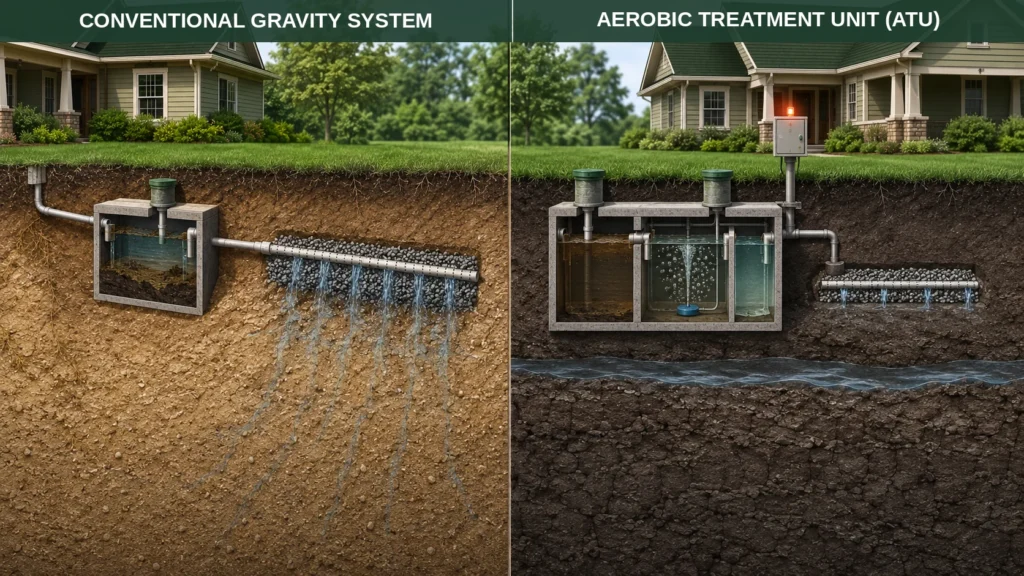
Quick answer: a conventional gravity system is simpler and cheaper, but needs several feet of good, permeable soil to work — something increasingly hard to find on Pierce County’s glacial till-heavy lots. An aerobic treatment unit (ATU) mechanically treats wastewater more thoroughly, allowing it to work on sites a gravity system couldn’t, at the cost of more maintenance and a higher price tag.
The Two Approaches:
Side by Side
- Simpler, fewer moving parts
- Lower cost to install and maintain
- Requires roughly 3+ feet of good, permeable soil
- Increasingly hard to site on till-heavy lots
- Mechanically aerates for more thorough treatment
- Works on sites poor soil rules out for gravity systems
- More moving parts — blower, alarms, controls
- Higher cost, and typically requires an annual O&M service contract
Your soil conditions — not personal preference — usually determine which type your property qualifies for.
Why Soil Drives This Decision
A conventional gravity system relies entirely on the surrounding soil to filter and treat effluent as it percolates through the ground — which means it needs enough depth of genuinely permeable soil to do that job. As we cover on our soil and drainage page, much of Pierce County sits over glacial till that simply doesn’t drain well, which is exactly why gravity systems are becoming harder to site here compared to other parts of the country. An ATU essentially does part of that treatment work mechanically, before the effluent ever reaches the soil — which is why it can be approved on sites a gravity system would fail.
Get Free Quotes From Local Septic Pros
Three fields, about fifteen seconds. No cost and no obligation.
We pass your request to licensed local companies so they can quote you directly. Your details are never published or sold on.
The Maintenance Trade-off
ATUs have real moving parts — a blower or aerator, electrical controls, and alarm systems that alert you if something stops working. That means more that can go wrong mechanically compared to a gravity system, and it’s exactly why TPCHD requires more frequent O&M inspections for systems with mechanical components (see our O&M inspection guide) — typically annual rather than every three years. Most ATU installations also come with a required service contract with the manufacturer or a certified provider, which is an ongoing cost worth budgeting for beyond the initial installation.
Which One Will You Actually Get?
This isn’t really a preference decision. A licensed designer’s site evaluation — soil type, percolation results, lot size, and proximity to water bodies — determines which system types your property actually qualifies for. If you’re planning new construction or a system replacement, it’s worth understanding this early, since it affects both your upfront budget and what you’ll be maintaining for years afterward.
Planning a new system or replacement and want to know which type fits your property? Connect with a local licensed septic provider.
Need Help With Your Septic System?
Tell us what’s going on and we’ll connect you with a licensed Pierce County provider. Free, and no obligation.
Independent — not affiliated with the Tacoma-Pierce County Health Department or any county health department, and not a septic contractor.
Frequently Asked Questions
What's the main difference between an ATU and a conventional septic system?
A conventional system relies entirely on soil to treat effluent, while an ATU mechanically treats wastewater first, allowing it to work on sites with poorer soil conditions.
Why do ATUs need more frequent inspections?
Because they have mechanical components — a blower, controls, and alarms — that require more oversight than a simple gravity system, which is why TPCHD generally requires annual rather than tri-annual O&M inspections for these systems.
Are ATUs more expensive than conventional systems?
Yes — both to install and to maintain, typically including a required ongoing service contract.
Can I choose which type of system I want?
Not really — your site evaluation (soil type, percolation results, lot size, proximity to water) determines which system types your property actually qualifies for.
Why are ATUs so common in Pierce County specifically?
Because glacial till soils limit where conventional gravity systems can be sited, making engineered alternatives like ATUs a common necessity rather than a preference.