Sourced from Pierce County Public Works geological documentation and WSU Extension soils research — last checked July 2026.
Quick answer: most of Pierce County’s soil was left behind by retreating glaciers, and much of it sits over a dense, nearly impermeable layer called glacial till (often called “hardpan”). Where till sits close to the surface, water can’t drain through it, which limits how well a standard gravity drainfield can work — and it’s a big part of why so many properties in this region use engineered alternatives instead of a simple gravity system.
Why This Matters More Here Than in Most Places
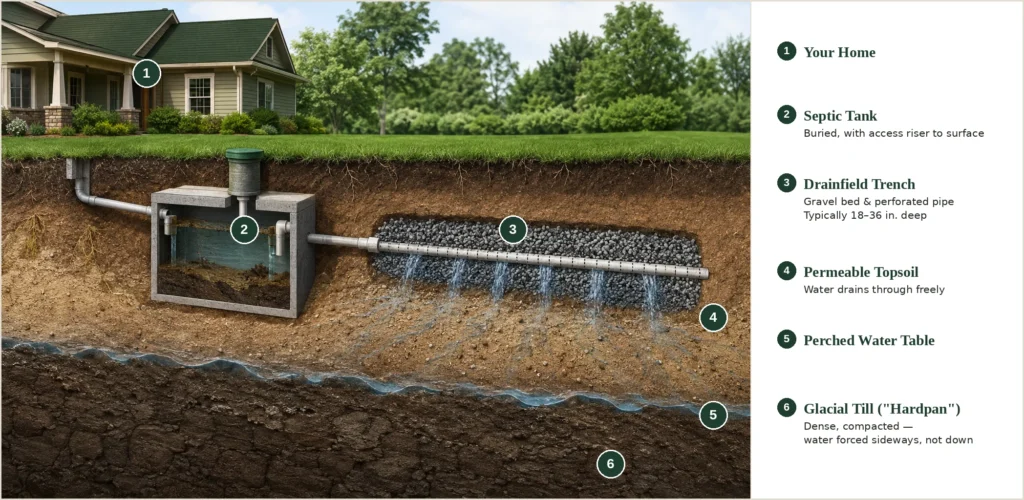
Pierce County’s soils are largely the product of glacial deposits. The upper layer is often reasonably permeable, well-drained soil — but underneath it, many areas have a layer of basal till: dense, compacted material left behind by the glacier itself, often nearly impermeable to water. Pierce County’s own planning documentation notes that soils with this kind of cemented hardpan create “perched aquifers” where traditional septic systems cannot function properly. When water hits that layer, it has nowhere to go but sideways, which is exactly the mechanism behind a lot of the drainfield problems we cover elsewhere on this site.
It Varies a Lot by Neighborhood
This isn’t uniform across the county. Different drainage basins have distinctly different soil associations — the Nisqually River basin includes Kapowsin, Alderwood-Everett, Puyallup-Sultan, Barneston-Scamman-Wilkeson, and Spanaway soil types, while the Gig Harbor and Kitsap basin areas include Everett, Sinclair, Alderwood, Indianola, and Harstine soils. Some areas are far more limited than others: Fox, McNeil, Ketron, and Anderson Islands, along with large portions of the Gig Harbor and Longbranch peninsulas, have historically been classified as severely limited for septic suitability. If you’re evaluating a property, this is a very reasonable thing to ask a designer or the seller about directly.
Get Free Quotes From Local Septic Pros
Three fields, about fifteen seconds. No cost and no obligation.
We pass your request to licensed local companies so they can quote you directly. Your details are never published or sold on.
Why This Drives System Choice
A standard gravity septic system needs roughly three feet of good, permeable soil to work reliably. Because till soils are so common across the region, finding a lot that actually qualifies for a simple gravity system is becoming less common — which is a major reason engineered alternatives like aerobic treatment units, sand-lined systems, or mound systems show up so often in Pierce County compared to other parts of the country. (We cover that comparison in more detail on our ATU vs. conventional systems page.)
What This Means for Site Evaluation
This is exactly why a licensed designer’s site evaluation matters so much before installing or replacing a system. Percolation testing is typically done at the proposed drainfield depth — commonly 18 to 36 inches below the surface — and has to account for the seasonal high water table, not just a single dry-season snapshot. A site that looks fine on a summer afternoon can behave very differently after a wet Pacific Northwest winter.
A Related Factor: Mature Landscaping
Many established Pierce County properties also have significant mature trees and landscaping. Roots from trees planted too close to a septic system can intrude into pipes, cause obstructions, and even crack tank components over time — worth keeping in mind if you’re landscaping near a drainfield, or evaluating a property with large trees already close to one.
Wondering what your specific property’s soil means for your system? Connect with a local licensed septic provider.
Need Help With Repair or Problem?
Tell us what’s going on and we’ll connect you with a licensed Pierce County provider. Free, and no obligation.
Independent — not affiliated with the Tacoma-Pierce County Health Department or any county health department, and not a septic contractor.
Frequently Asked Questions
Why is septic drainfield suitability such a big deal in Pierce County specifically?
Much of the county’s soil sits over glacial till, a dense layer that water can’t pass through easily, which limits how well standard gravity drainfields function in many areas.
Does every property in Pierce County have this problem?
No — it varies significantly by neighborhood and soil association; some areas are far more limited than others, and a site evaluation is the only way to know for sure.
How deep do percolation tests typically go?
Commonly 18 to 36 inches below the surface, at the depth the drainfield itself is proposed — and testing has to account for the seasonal high water table, not just dry-season conditions.
Why are alternative systems like ATUs so common here?
Because a standard gravity system needs several feet of good permeable soil, which is increasingly hard to find on till-heavy lots — alternative systems can work on sites gravity systems can’t.
Can tree roots really damage a septic system?
Yes — roots from trees or large shrubs planted too close to a tank or drainfield can intrude into pipes and cause cracks or blockages over time.